
Science is Good Business
- Jeanna Winchester PhD

- Mar 1
- 25 min read
Updated: May 18
It's worth trillions.
March 1, 2026
Science is Good Business
Science is beautiful. It is discovery, incarnate.
If you are lucky enough to be a scientist, you’ll never wonder what it’s like to see the unknown. The unknown is a mirror of yourself. It is your guide through existence. It is the thing that makes every day interesting. I can’t explain what it means to journey into the unknown and see the secrets others don’t even know they want to find. I enjoy every minute of it, even on the hard days, and it seems like the answers will never come. But then, in an instant, discovery finally finds you. It’s worth everything in that moment.
I regret nothing.
As a scientist, I’ll be the first to admit my bias: I truly believe that research and technology are the heartbeat of our shared success. While the “turn of the millennium” might sound like ancient history, it’s but a blink of an eye. Modern lifetimes are longer than they’ve ever been, with Gen Z and Gen Alpha likely to see 2116—a direct result of the scientific leaps we’ve made since 2000.
These last 25 years have completely rewritten how we exist, and in this article, we are going to explore just 25 areas where those innovations have shaped our lives. There are so many more and each of these areas could include hundreds of advances, but I’m going to try to keep it more general and something we would probably talk about a kitchen table, drinking a beer.
America’s Status As A Global Leader Didn’t Happen By Chance.
For over 125 years, the US has essentially functioned as the world’s laboratory. This long history can be broken down into two major waves that set the stage for the trillion-dollar tech giants we see today.
First came the Giants of the Industrial Age. Think of Thomas Edison, who turned a record-breaking 1,093 patents into a literal empire of light and power, or the Wright Brothers, who turned a 1903 flight into the foundation of global trade. During this era, researchers like Barbara McClintock were also digging into “jumping genes,” a scientific breakthrough that laid the groundwork for today’s multi-billion-dollar biotech industry.
Then came the Architects of the Digital Revolution.
In 1947, physicists at Bell Labs invented the transistor—a tiny device that replaced massive, room-sized vacuum tubes. This single invention is the heart of every smartphone and AI chip we use in 2026. While pioneers like Grace Hopper taught computers how to understand our language, young innovators figured out how to put that scientific magic into every home through easy-to-use software. By turning complex lab experiments into everyday tools, these pioneers proved that the best way to build a massive business is to solve the hardest scientific puzzles first.
Ultimately, this rapid evolution is the backbone of the $30 Trillion US economy. By shifting from heavy manufacturing to Deep Tech, we’ve proven that investing in “boring” basic research eventually creates the “exciting” trillion-dollar industries of tomorrow.
It’s a simple truth: Science is Good Business.

The Fantastic Four
The landscape of science is shifting. If you looked only at the stock market, you’d see the S&P 500 up 365% and the Nasdaq-100 up 500% since 2000. But those numbers mask a long 15-year recovery from the Dot-com crash and don’t fully capture the global R&D explosion. Global research spending has tripled to $2.4 trillion since 2000, and the US is no longer the sole titan.
The silver medal goes to China, as many of us know. Once a mere member of the top 10 prominent science R&D players, by 2024, China’s adjusted spending of $785.9 billion officially edged out the US total of $781.8 billion. While the US innovation engine is powered by private companies (driving 83% of growth), they often focus on “quick-to-market” products. This has left a void in the fundamental “basic research” that the US government used to lead.
Now that the US government no longer leads the scientific community, we are expected to lose our place as the frontrunners of innovation in the next 5-10 years. That hasn’t been true for 125 years.
As of 2026, the global economic map has been redrawn. The US remains a financial anchor, but the growth story has moved toward what I like to call “The Fantastic Four” of the new millennium:
United States: Leads in AI software and utility, though we are hitting a wall with massive data center power demands.
China: A “Green Superpower” that dominates the global supply of EVs and batteries.
European Union: Modernizing legacy industry by using “Digital Twins” to slash factory emissions by 30-40%.
India: Growing at a blistering 6.6%–7.6% by digitizing its economy through a national payments infrastructure. India’s surge from $0.47 trillion in 2000 to $4.5 trillion today means it now contributes more to global growth (17%) than the US (9.9%).
This is the state of science today.
Adapt Or Die
Judging a science and technology company today is about more than just profit; it’s about how well a business turns raw science into market dominance. The new millennium has proven that Science is Good Business, but only if you know how to measure the engine under the hood.
To see if a company is truly winning, you have to look at R&D Intensity—the percentage of their paycheck they plow back into research. In 2026, the best firms spend roughly 15–20% on new ideas. If they spend less, they are just coasting on their passing fame. They have to chase the Total Addressable Market, or the “dream big” number.
For example, while the market for Cloud Computing was practically zero in 2000, it is worth trillions today.
Success also means surviving the Valley of Death: that risky gap where a lab discovery tries to become a product people actually buy. In a massive shift, these invisible assets now make up over 90% of the S&P 500’s value.

The playbook for success has also changed.
We moved from the “growth at all costs” perspective of 2000 to an era of efficiency in 2026. Now, science and technology use the Rule of 40, meaning a company’s growth and profit margins combined should hit at least 40%. It’s no longer just about making things smaller. The focus is more on Wright’s Law, which says the more we build something (like EVs or solar panels), the cheaper and better we get at making it.
One of the newest measures that has shaped the business of science is National Security Utility.
If a company makes something vital to US survival (like advanced AI or microchips), it gains Strategic Value. These companies often get government support because their success is tied directly to the country’s success. It’s one of the few areas of science and technology the US government is still a leader in.
The takeaway? When science is managed with these new metrics in mind, it doesn’t just change the world—it builds the most valuable companies in history.
The Elephant in the Room: NVIDIA
I know. I know. It’s a shock that I’m not gushing on Google, but don’t worry, Alphabet is all over this bitch.
NVIDIA is a key example that Science is Good Business. By betting on deep, difficult research, they transformed from a small company making chips for video games into the architect of a $30 trillion US economy.
Their success comes from weaponizing their research budget. In 2026 alone, NVIDIA spent a record $16.7 billion on R&D, ensuring it stays years ahead of everyone else. While they used to sell mostly to gamers, they now sit at the center of a $600 billion spending spree by tech giants like Google and Microsoft, who need NVIDIA’s chips to build AI data centers. Their financial health is essentially off the charts; they’ve achieved a “Rule of 40” score of 106.5%, meaning they are growing at a breakneck pace while keeping nearly 75 cents of every dollar they make as profit.
NVIDIA’s real power lies in a “moat” they built around their R&D royal castle years ago.
By creating a software system called CUDA, they ensured that almost every AI developer in the world learned to code on their hardware. This makes it nearly impossible for competitors to topple them. Today, NVIDIA is more than a company; it’s the quintessential national security asset. Their chips are so vital for everything from defense to “Sovereign AI” that countries now buy them with the same urgency they once had for oil or gold.

The Bottom Line: By 2026, NVIDIA became the first company to hit a $5.0 trillion market cap. They proved that when you invest in the hard science and create a platform everyone must use, you don’t just win a market—you define an entire era of human history.
Which Brings Us To The Magnificent 7
The “Magnificent Seven” consists of Apple, Microsoft, Alphabet, Amazon, Meta, NVIDIA, and Tesla, and has its own ETF. Known as the “Mag 7,” since 2000, these companies have evolved from ambitious startups into the actual backbone of the world economy. Their combined value has skyrocketed from $244 billion to a staggering $21.7 trillion.
To put that in perspective, the Mag 7 are worth more than the entire stock markets of Japan, Canada, and the UK combined.
This massive growth wasn’t a stroke of luck; it was deliberate. By 2022, the Mag 7 was responsible for nearly 40% of all corporate R&D spending in the US. It is hard to go to one household in the US and not see one of their products. They are everywhere, and not just in the US; they are the dominant companies worldwide. A major secret to their success has been becoming Hyperscalers. Think of them as the 21st-century landlords of the internet.
And they aren’t even the most impressive thing to come out of US science. This millennium has been a full-on reformation that dwarfs everything that came before. The 1900s were impressive for US science and industry, but this century has propelled us to heights we didn’t imagine. So let’s take a look back at how far we’ve come since the clock hit 12:01 am on January 1, 2000.
I know they’ve changed my life!

25 Areas of Science That Have Changed The Future of Humanity In 25 Years
Consciousness Cannot Be Gamed, But It Sure Loves Gaming.
This one may not seem intuitive, but, since 2000, the world of games and toys has shifted from a kids’ hobby into a $250 billion global engine. This transformation demonstrates how Science is Good Business, as the technology we built for fun now runs everything from hospitals to national defense.
Today, the gaming industry actually earns more revenue than the movie and music industries combined, moving from one-time store purchases to a constant digital stream of subscriptions and virtual goods.
The magic is how gaming accelerated serious research. To make games look realistic, companies like NVIDIA perfected the GPU. While these chips were originally made to render game explosions, in 2026, they are the brains behind the world’s most advanced AI and medical imaging. Meanwhile, the same software engines that power titles like Fortnite are now used by engineers to build Digital Twins—virtual copies of cities used to test fire safety or hurricane resilience before building in the real world.
Even the toy box has gone high-tech. Modern toys use AI to adapt to a child’s learning level, making the toy industry a major player in robotics and education. This evolution shows that play is the ultimate laboratory. By chasing better graphics and smarter toys, we built the hardware and software that now run the modern world. In 2026, when you see a kid playing a game, you’re actually looking at the R&D department for the future of American business.
Agriculture Is Not For The Faint Of Heart
Admit it. You know what farms are, but have never seen one. I’m telling you, it’s a whole thing! You think it’s just some backwoods lifestyle, but now, American agriculture has traded intuition for information, evolving into a $1.5 trillion data-driven beast. GPS and soil sensors allow Variable Rate Technology (VRT) to feed and water plants individually rather than field-by-field. This precision saves farmers billions in wasted resources.
The current workforce has gone autonomous.
With laser-weeding robots and AI that diagnoses crop diseases from satellite images, farmers have become Data Managers. By catching problems before they spread and replacing heavy chemicals with light-based weeding, the US has maintained its status as the world’s breadbasket while slashing overhead. In 2026, the American farmer isn’t just growing food—they are running a sophisticated business where deep science protects the bottom line.
That Talky Talky Talk Talk
The world has basically shrunk. We’ve moved from a society of checking in on landlines to being always on, turning the way we talk into one of the most valuable industries on the planet. In 2000, your desk was a graveyard of gadgets like fax machines and pagers; today, those have been swallowed by the smartphone, which acts as a portable laboratory for the entire digital economy.
The secret to this growth was the invisible science of connectivity. We traded clunky dial-up cords for the “wireless revolution” of 5G and 6G. This wasn’t just about faster texting; it required massive research into data compression and radio frequencies to turn “signals” into a trillion-dollar commodity. This infrastructure flipped the media world on its head, moving us from 24-hour news cycles and paper newspapers to a “Creator Economy” where everyone is a broadcaster, and news travels in seconds.
The communication revolution shows that speed is wealth. By investing in the science of how we connect—moving from the clunky fax to instant, satellite-linked smartphones—the US turned the simple act of talking into the primary engine of economic growth. In 2026, the world is smaller and faster, proving that the more we can share, the more the economy grows.

The Centrifuge Is Making That Noise Again 😑
American Biotechology has moved from just patching up symptoms to actually rewriting our biology, creating a massive $30 trillion industry. This proves that science is the ultimate “money-making machine” because, at the end of the day, a healthy country is much cheaper to run than a sick one.
Spending $2.2 million once to cure a disease like sickle cell sounds like a lot, but it saves $6 million in lifetime hospital bills—that’s just good math. We’re seeing the same wins with cancer treatments that act like heat-seeking missiles and breakthroughs that slow down Alzheimer’s disease, saving billions in nursing home costs. Today, the most valuable thing a company can own isn’t a factory; it’s the patent on a cure. Investing in deep science isn’t just a “nice to do,” it’s the smartest business move we’ve ever made for a profitable future.

Please Remove All Metal Objects Before Entering The MRI Suite
Modern medical imaging has transitioned from blurry snapshots to precise digital maps, with the US market projected to exceed $50 billion by late 2026. Bulky machines have evolved into handheld, smartphone-compatible devices, democratizing life-saving diagnostics for rural patients.
The integration of AI acts as a vital second set of eyes, while molecular imaging accelerates drug development by monitoring cellular reactions in real-time. By prioritizing these portable and predictive technologies, the healthcare system has successfully lowered costs while improving both patient longevity and profitability.
Thanks to COVID-19, I Know What A Supply Chain Is!
Moving things from point A to point B has evolved from a back-office chore into a high-tech science. We’ve discovered that the math of moving boxes is one of the most profitable investments a company can make. In the early days, warehouses ran on clipboards and gut feelings, but now use improved technologies that reduce the burden of injury on their employees’ bodies.
Retail giants now use predictive shipping to move products closer to your neighborhood before you even click buy. By solving millions of complex problems every day, these companies find the fastest, cheapest routes for every truck. This doesn’t just pad their profits; it lowers the cost of living for families and fuels the whole economy. Treating the supply chain like a hard science makes companies smarter, greener, and much more successful. In 2026, the lab bench has officially moved into the loading dock.

The Microchip
I’ve already mentioned NVIDIA and the growth of microchips, but they aren’t the only players. Other companies like TSMC, Samsung, Intel, Broadcom, AMD, Qualcomm, and Google, with its Willow, the first quantum chip, are just some of the giants in an industry we can’t live without. These tiny slivers of silicon are the “new oil.”
In 2000, a top-tier chip held about 37 million transistors; today, we pack over 200 billion onto a piece of silicon the size of a fingernail. Because owning the science behind the chip is now the only way to win at business, every major tech player is designing their own custom silicon to run the Cloud and AI.
Are You Scrolling Again?
The end of the last millennium set the stage for the Online Revolution, where 95% of Americans are constantly connected. This isn’t just about social media; the digital economy now generates $4.9 trillion and 28.4 million jobs, spitting out about 18% of the US’s total GDP.
This shift transformed the American workforce and the scientific lab. In 2026, there are over 28 million internet-related jobs, and the “Creator Economy” is outgrowing traditional media five times over. For scientists, the internet became a “Super-Laboratory.” Because data now moves in milliseconds rather than months, researchers can collaborate globally to achieve feats like developing vaccines in under a year—a task impossible with 2000-era tech.
Today, the market values “intangibles”—like software and AI algorithms—over physical factories. With US R&D spending approaching $1 trillion annually, the internet has become the primary engine of our national wealth. In 2026, the digital world isn’t just a place to visit; it’s the high-tech laboratory where the next millennium is being built.
A Cat On A Laptop Going Clackity Clack Clack
Computers have moved from a bulky box on a desk to a force that powers every second of American life. This shift created a $5 trillion “App Economy” that simply didn’t exist twenty-five years ago. For businesses and schools, the Cloud changed everything. Instead of buying expensive hardware, even the smallest startup can now rent world-class computing power, allowing them to innovate as fast as a giant corporation. This “digital layer” over the real world has turned every home and classroom into a hub for global commerce.
The real magic, however, is happening behind the scenes in research. AI-powered systems now run millions of simulations in hours that used to take weeks. This speed is why we’re seeing a “Golden Age” of new medicines and materials. By making science faster and more accessible, the US has ensured that the laboratory is no longer a distant building—it’s where all modern business happens.
Now, the computer isn’t just a tool; it’s a collaborator that adds trillions to our GDP by making the impossible profitable.

Healthcare Is A Fundamental Right
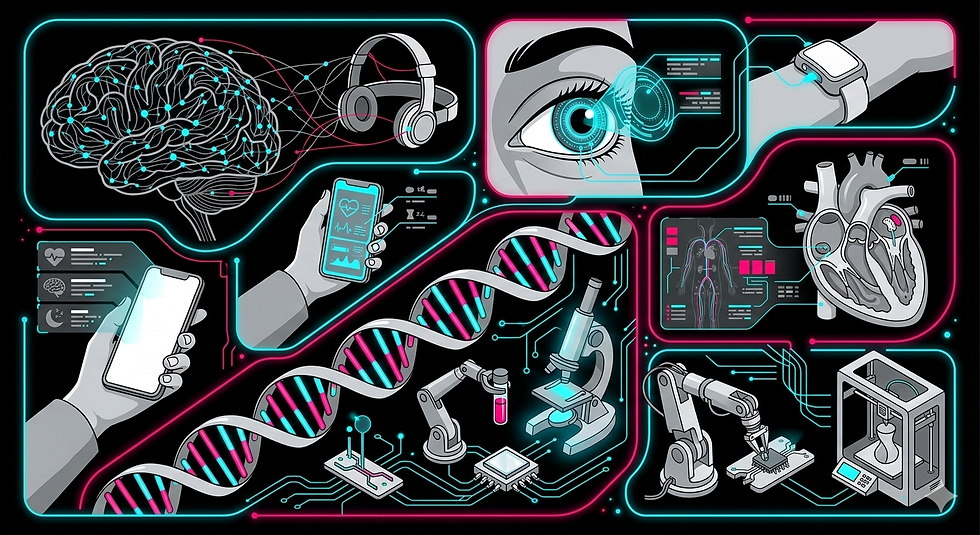
By ditching filing cabinets for digital networks, healthcare has shifted from reactive repairs to predictive prevention. Electronic Health Records (EHRs) now use AI to scan millions of data points, catching issues like heart attacks before they occur. This move toward Value-Based Care prioritizes patient outcomes over the volume of tests performed.
Modern medicine is now “frictionless” and portable. Telehealth and wearables provide a 24/7 safety net, while robotic surgery ensures faster recovery times. By catching illness early, we maintain a more productive workforce and a healthier national economy.
Taking Control Of Our Health
We’re no longer waiting to get sick. We steer our own health. This move toward personal control has turned the US wellness market into a massive $1.8 trillion powerhouse by 2026. By putting scientific tools in our pockets, we’ve created a world where staying healthy is a high-tech industry that keeps the American workforce running longer and more efficiently. Even mental health has become an economic driver with apps like Calm becoming billion-dollar unicorns because meditation and sleep are just as vital to the bottom line as heart health.
An empowered patient is a more “profitable” citizen. We’ve merged the doctor’s expertise with 24/7 real-time data, creating a new economic sector that values prevention over repair. Taking care of yourself is no longer just a personal choice—it’s a sophisticated business that saves the country billions in long-term costs.
(Give shoutout to Gemini for collaborating on the graphics! LOVE YOU🫶)
Is It Weird That I Feel Like America’s Greatest Achievement Is The Swiffer?
No cap. But also… techy fits.
Our homes have transformed from a collection of stuff into a science fiction ecosystem. Since 2000, the household product industry has shifted from selling one-off products to providing intelligent services. Inside the house, the Smart Home has turned the boring thermostat into a machine-learning tool that slashes energy bills by 15%, while appliances now monitor their own health and order their own replacement parts.
Even the chemistry of our cleaning supplies has evolved. To save money and the planet, companies used Material Science to ditch toxic ingredients for plant-based cleaning products. By merging economics with sustainable environmental practices, businesses have slashed costs, improved energy efficiency and cut waste management. It’s a perfect example of how Green Chemistry is actually a massive business pivot—proving that sustainability is often the most profitable way to operate.
The Bottom Line: In 2026, your home runs on the cutting edge of research. From the molecular structure of your soap to the AI in the delivery drone at your door, applying science to daily life has made the American household more efficient and the national economy more resilient.
Burn Calories, Not Fossil Fuels
The US has pulled off a total energy 180, turning a fear of running out of fuel into a high-tech era of super-abundance. We’ve proven that Science is Good Business by treating energy like a technology rather than just something we dig out of the ground.
The first big leap was the digital revolution in traditional energy. Using AI and imaging to find resources with pinpoint accuracy, the US transformed from a major importer into the world’s leading energy producer. But the real change has been the Electrification Economy. Thanks to batteries getting 90% cheaper since 2010, millions of Americans now swap gas for hybrids and EVs, while solar power has become the cheapest electricity in history.
Today, the grid has become a “smart” network. Many homes act as mini-utilities, selling power back to the grid, while massive AI data centers are being powered by “plug-and-play” mini-nuclear reactors. We’ve even moved into the science fiction realm, with record investments in fusion energy, literally trying to bottle the power of the stars.
By investing in the science of how we move and store electrons, the US has lowered costs and created millions of new jobs. In 2026, energy is no longer just a commodity we buy; it’s an innovation we own, providing the ultimate foundation for a profitable, high-tech future.
Come On People, Bikes Are A Great Form Of Transportation!
Transportation has evolved from a greasy mechanical industry into a more than $1.9 trillion high-tech sector where information is the new horsepower. In the driveway, the family car went from a gas-powered giant into a smartphone on wheels. Thanks to the falling cost of batteries, EVs now make up over 20% of new sales because they’ve become more profitable to build than gas cars. The biggest jumps in recent times were in 2024 and 2025. Tariff policies are causing a slight pullback, but estimates still expect over 20% in 2026.
Beyond the driveway, the business model has flipped to Active Transportation, Microability, and Mobility as a Service. Over 100 million Americans now use apps for everything from ride-hailing to electric scooters, filling the gaps in public transit with data-driven precision. With over $100 billion spent annually on autonomous driving research, we are seeing the first robotaxi fleets and cars that use “computer vision” to prevent accidents before they happen. By investing in the science of batteries and sensors, the US has turned a 100-year-old industry into a high-growth frontier.
Drones
Today, March 1, 2026:
When I first wrote this article a week ago, the world looked much different. In just the last 72 hours, the US Executive Branch engaged our military forces into a formal wartime conflict with Iran. For Millennials, this is a life we know all too well. I watched the Towers fall—the fire, the shattering glass, the bending metal, and the souls that removed themselves from their fate when there was no way out.
The bright future and the promise of a new millennium filled with prosperity, which the adults of the 90s guaranteed us, came crashing down with that second Tower, and our dreams fell with it.
To any Gen Z or Gen Alpha reading this now or in the future: I ask only one thing. If you need to talk to those who understand the weight of an endlessly protracted war that was supposed to take only a few weeks, where your siblings, friends, and neighbors are sent to places where the oil fields burn, and IEDs become a household acronym, please turn to us. When the children of Millennials are old enough to be sent to the very same war we’ve been fighting since the second plane hit the South Tower at 9:03 a.m., 9/11/2001, I hope you will turn to them. We must lean on one another. We are human, and humans need humans.
I had already started next week’s post, but I am rescheduling it. Instead, I want to dive deeper into why “Humans Need Humans.” We will look at how psychology has evolved alongside our technology and access, but with a much greater emphasis on our fundamental human need for connection.
The key is to understand that—as I mentioned in Human Verified: Resistance is Futile—the risk doesn’t lie in the technology or the progress itself. The risk lies in the intention of the person who uses it. Ever since we first developed opposable thumbs, our advancement has been a tool for both peace and prosperity, as well as war and dominance. Drones are no different. Every single area of science discussed today, and so many more, has been weaponized and militarized. It is so human.
So, to go forward with the text I wrote last week, let’s continue:
In just 25 years, drones (aka Unmanned Aircraft Systems or Unmanned Aerial Vehicles) have leaped from secret military tech to the unseen workers of our economy. By turning complex math into a $20 billion industry, we’ve made everything from home delivery to infrastructure repair faster, cheaper, and safer.
We’ve moved through three quick stages: first, the military seeded the ground with GPS. Then, cheap smartphone parts let hobbyists take flight. Finally, we entered today’s industrial era. This efficiency is a massive win for the bottom line, lowering costs for everyone. Investing in the science of flight, whether they are the size of a school bus or a notebook, hasn’t just given us cool tech—it’s built a smarter way to run a country.
Personal, Local & National Security
Security has moved from physical deadbolts to invisible lines of code. What used to be about locks and fences is now a multi-trillion-dollar industry driven by AI and data. This shift hasn’t just made us safer; it’s become a massive engine for US economic growth.
In the early 2000s, cybersecurity was just about stopping basic computer viruses. T
oday, it’s a $200 billion industry essential for national survival. Because our power grids and banks are online, the US now uses advanced science like Quantum Cryptography and AI threat hunting to protect our digital borders. This predictive science saves companies billions by stopping hackers before they even break in, and AI has become a fundamental initiative for US national security.
Closer to home, the smart house has turned basic safety into a booming subscription business. In 2000, an alarm was just a keypad that beeped; in 2026, 70 million American households use AI cameras and doorbells that can tell the difference between a cat and a package thief. By turning things like facial recognition and biometric sensors into everyday tools, tech giants have integrated high-level science into our kitchen-table lives.
The last 25 years have proven that protecting people is a premier growth industry. By investing in the science of “trust,” the US hasn’t just built a shield—it’s built a more profitable economy where innovation can flourish without fear.
Voice-Activated Technology
You used to have to live with the frustrating “Press 1 for Sales” phone menu. Then, scientists realized the innerworkings of speech recognition, building a process of capturing the audio, converting it to a signal, breaking down the sounds, deciphering the context, and executing the commands the person gave. It became a trillion-dollar engine that runs our lives.
Back in 2000, talking to a computer was a clunky science fiction dream. By 2026, it’s how over 150 million Americans order groceries, manage their bank accounts, and run their homes. The big breakthrough wasn’t just better microphones; it was Deep Learning. Scientists spent billions teaching AI to understand not just our words, but our actual intent. This research didn’t just give us smarter speakers; it created digital agents that now handle complex customer service and paperwork, saving US businesses an estimated $80 billion a year.
The Voice Economy is now a cornerstone of our GDP, turning everything from your thermostat to your car into a smart, voice-controlled device. For professionals like doctors and lawyers, these tools have reclaimed millions of hours once lost to typing, allowing them to focus on their actual work.
By investing in the impossible science of speech, we’ve turned the human voice into a high-efficiency business tool. Today, your voice isn’t just for talking. It’s a powerful asset that drives the modern economy.
I am Iron Man.
The shift in American entertainment from 2000 to 2026 is a perfect example of how Science is Good Business. In just one generation, we traded closets full of CDs and DVDs for streaming. This wasn’t just a change in how we watch movies; it was a total scientific overhaul that turned Hollywood into a branch of Silicon Valley, adding trillions to our economy.
In 2000, “on demand” meant a trip to Blockbuster. Today, digital media is a $600 billion engine where we treat entertainment like a utility—paying a monthly rent for access rather than owning plastic discs. This revolution was built on quiet science: high-tech video compression and lightning-fast 5G/6G networks that make high-def streaming possible on a phone.
We’ve even seen a Vinyl Paradox, where the physical science of record-playing became a premium luxury again, proving that tangible goods still have a seat at the table. In 2026, entertainment is a futuristic science fiction laboratory that keeps America at the heart of global culture.

Construction Is More Than Just Butt Cracks And Cat Calling
This millennium has brought about the construction technological renaissance. By merging digitization with physical materials, the manufacturing and construction sectors now pump over $3 trillion into the US economy. We’ve moved from simple assembly lines to 3D Printing, where we print everything from rocket engines to medical implants on demand. This shift has saved billions; companies no longer need massive warehouses full of spare parts—they just keep the digital code and print what they need when they need it.
Even the way we build skyscrapers has changed. Before a shovel hits the dirt, engineers create a Digital Twin, giving them a perfect virtual model that lets them simulate earthquakes or heat flow to catch mistakes before they happen. On the ground, we’re seeing “LEGO-style” modular construction, where entire rooms are manufactured in factories and snapped together on-site, cutting project times in half.
The hard science of the lab has also reached the job site through Smart Materials. Today, we use self-healing concrete that regrows over cracks and carbon-trapping bricks that help companies meet strict environmental standards. By investing in robotics and material physics, the US has turned its blue-collar industries into technological profit centers. In 2026, a factory isn’t just a place of sweat; it’s where American ingenuity is literally printing the future.
Digitizing Finance
Since 2000, we’ve completely rebuilt the engine of the American economy, proving that Science is Good Business. We traded shouting traders on the stock floor for high-speed servers that execute trades in nanoseconds. Today, algorithms do 60% of the heavy lifting, turning finance into a high-stakes field of computer science that keeps 401(k)s more stable and secure through AI-driven fraud protection.
For the average person, this means an invisible finance world. Money now moves like a text message, and big banks have been replaced by apps in your pocket that let you buy fractional shares for free. This digital “under-the-hood” reconstruction hasn’t just made life easier; it’s added $1.5 trillion to our GDP by making money faster, safer, and accessible to everyone.
Cryptocurrency Is Not Just For Bro Dudes
Once, cryptocurrency was a fringe experiment. Started as “funny money” in video games digital currency has become a trillion-dollar asset class. The breakthrough was Blockchain, a mathematical ledger that nobody can cheat.
This didn’t just create new wealth; it forced a massive leap in computer science, making the US a world leader in high-level security and cryptography. In the last 5 years we’ve added Stablecoins (digital dollars) and Tokenization to move real-world assets like stocks and houses instantly. And no, Tokenization is not a character from South Park. It’s a real thing.
It’s all about efficiency. In 2000, moving money across borders took five days and heavy fees. Today, it happens in seconds for a fraction of the cost. With 20% of Americans now using digital assets, we’ve removed the middlemen, adding an estimated $100 billion back into the global economy every year. By turning complex math into a secure way to trade, we’ve built a financial engine that never sleeps.
Blockchain Just Confuses Me
The world defines trust differently in both security and the centralization/movement of data. Instead of using old-school paper records, the world has moved to Blockchain. Often tied to Bitcoin digital currency, Blockchain has so many applications in decentralizing the storage and transfer of all kinds of data. US science turned complex math into the digital bedrock of a faster, more efficient economy. This is another example that Science is Good Business: we are successfully replacing expensive middlemen with unhackable code.
And it’s more than just supporting cryptocurrency. By 2026, major companies use this technology to track food from farm to shelf in seconds, stopping outbreaks and saving billions. We’ve also seen the rise of Smart Contracts, which are digital agreements that automatically settle a deal the moment the work is done, turning slow legal and insurance hurdles into instant tasks. Ultimately, by using digital security to replace the middleman, the US has built a high-speed infrastructure that makes global business more transparent, secure, and significantly more profitable.

Space
Space has gone from a government playground to a $1.1 trillion business powerhouse. We’ve stopped looking at the stars as a scientific hobby and started seeing them as the next great frontier for American growth, proving that “rocket science” is actually incredible for the bottom line.
The game-changer was solving the reusable problem. In 2000, we threw away every rocket we launched, which was like junking a 747 after a single flight. Today, self-landing, reusable rockets have slashed launch costs by 90%. This shipping discount has opened the door for thousands of new businesses.
Instead of school-bus-sized machines, we now launch shoebox sized satellites that beam high-speed internet to every corner of the globe and provide real-time data that helps farmers predict crops and investors track global trade.
Space isn’t just a place to visit. It’s a place to work. Companies are now using the weightlessness of orbit to manufacture medicines and several other things that simply can’t be made on Earth, something we talked about above. We’ve moved from the government-run Space Shuttle to a private-sector era where the sky is no longer the limit. It’s our future.
Changing How We Learn
We’ve traded heavy textbooks and one-size-fits-all classrooms for a digital, lifelong learning experience. Education is no longer a four-year pitstop; it’s a constant engine for the economy, turning the act of learning into a global export. In the early 2000s, online school was a clunky afterthought. By 2026, it’s the heartbeat of the system, helping people develop high-paying skills on the weekends. By moving education into the digital world, we’ve made knowledge more personalized and profitable. Today, the American workforce stays ahead because our classrooms are now sophisticated and never stop evolving.
Algorithms, Models & Artificial “Intelligence”
Don’t get me started on what intelligence really means. I’m a neuroscientist. I have a whole tea session on this that we don’t need to get into until a later date 🫖👀
We’re getting to the point where smart machines can actually learn and solve problems on their own. AI is no longer just a “cool demo”—it’s a serious collaborator adding trillions to the global economy by doing everything from writing code to designing life-saving medicines in record time.
Science has truly become the ultimate business partner. In the old days, testing a new drug or weather model took years; today, AI runs millions of digital experiments in hours, speeding up breakthroughs ten times over. It’s also made technology accessible to everyone: you don’t need to be a computer scientist anymore because anyone who can speak plain English can now use AI to build an app or run a business.
Ultimately, the last 25 years have shown us that the smartest companies win and that science is great business.

The Human Verified Reality Check
The Human Verified reality check on the last 25 years reveals a simple truth: Science is the best investment we’ve ever made, but it’s not a magic wand.
While we’ve built a $30 trillion economy on “invisible assets” like code and patents, the human experience has become a “Trust Paradox.” In 2026, we have the technology to live to 100, but we are still using 1900s rules to decide who gets the cure.
Digital tools have saved “centuries” of research time, but the average worker doesn’t feel the relief. We’ve automated the boring stuff only to fill that extra time with endless pings and meetings about the automation. Furthermore, science has become a lot more expensive. Today, a leading AI model requires the budget and power of a small nation. This has concentrated power into a few massive tech giants that are now essential to national security.
After twenty years of perfecting the algorithm, we’ve hit a 2026 reckoning: you can’t eat code.
Investors are now paying a trust premium for Human Verified results, favoring companies that can prove a real person, not a black box AI, make decisions. For Gen Z and Gen Alpha, success isn’t just about having the best science; it’s about having the best human systems to manage it. We are moving toward a Human-AI Collaboration where the most secure jobs belong to those who can bridge the gap between high-tech discovery and real-world utility. As we look toward 2116, the lesson is clear: we invest in the lab to create wealth, but we invest in Human Verification to ensure that wealth actually serves us.
Thank you for spending this time with me today.

All Content, Audio, Visuals & Imagery Are Property of JWPhD
Copyright 2026

Don't forget to check out Human Verified on Social!
I hope you will Like, Share, Follow, Subscribe and Comment below.



Comments